The process sounds deceptively simple — pack sand around a pattern, pour in metal, break it apart. But the mechanics underneath that description involve controlled chemistry, fluid dynamics, and thermal management. Get any one of those variables wrong, and the part comes out porous, warped, or dimensionally off.
This guide covers exactly how sand casting works, from pattern creation through finishing — including the process variables that actually determine quality.
Key Takeaways
- Sand casting uses compacted sand molds to shape molten metal into solid parts — the mold is destroyed after each pour
- The process sequence: pattern → mold assembly → pouring → cooling → shakeout → finishing
- Sand chemistry (grain size, binder, moisture) directly controls surface finish and dimensional accuracy
- Works with aluminum, iron, steel, and brass; aluminum's lower pour temperature makes it especially compatible
- Green sand (clay + water) suits high-volume, cost-sensitive runs; no-bake resin binders deliver tighter tolerances
What Is Sand Casting?
Sand casting is a metal forming process in which molten metal is poured into a cavity formed by compacted sand, allowed to solidify, and extracted by breaking the mold apart. ASM International defines it as gravity pouring liquid metal into a mold made from a mixture shaped against a permanent pattern — the pattern is reused, the sand mold is not.
The process exists to solve a specific manufacturing problem: how do you produce complex metal shapes without paying for expensive permanent tooling? A sand mold can be made from wood, plastic, or metal patterns at a fraction of the cost of a steel die, making the process accessible from single-unit prototypes to mid-volume production runs.
How It Differs From Other Casting Methods
| Method | Mold Material | Tooling Cost | Tolerance | Best For |
|---|---|---|---|---|
| Sand casting | Expendable sand | Low | Moderate | Complex shapes, low-mid volume |
| Die casting | Permanent metal die | High | Tight | High-volume, thin-wall parts |
| Investment casting | Ceramic shell | Medium-high | Very tight | Intricate, high-precision parts |
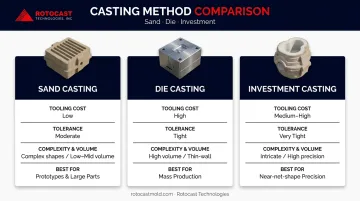
Sand casting trades some dimensional precision for lower tooling cost and far greater flexibility on part size. For large parts, complex geometries, and metals like aluminum, that tradeoff is a genuine advantage — not a workaround.
How Sand Casting Works
Sand casting operates through a defined sequence of stages. Each stage builds directly on the last.
Step 1: Pattern Creation and Mold Assembly
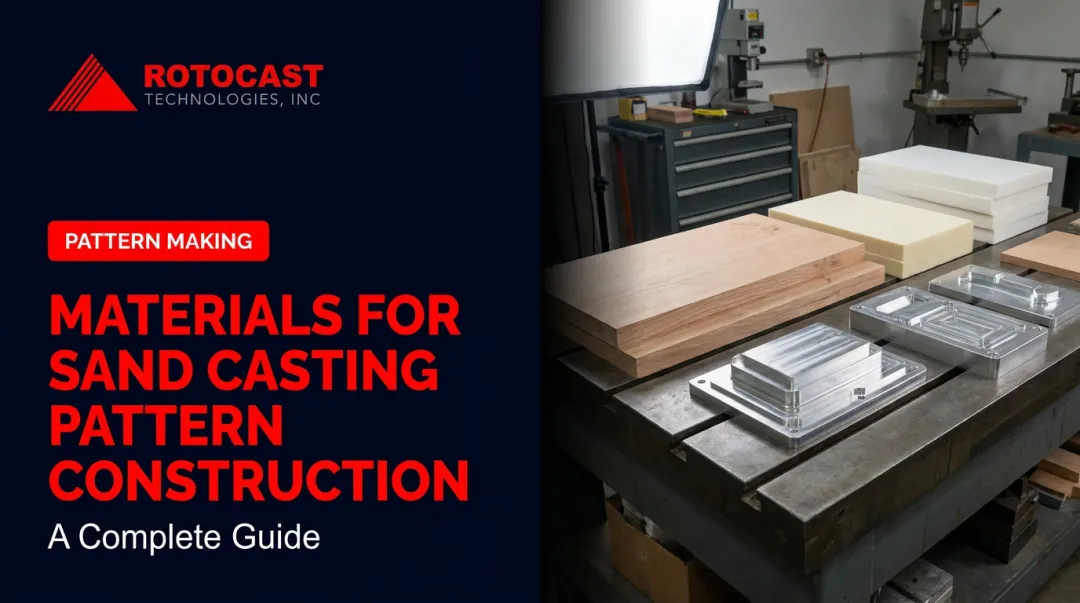
The process begins with a pattern (a physical replica of the final part), typically made from wood, metal, or plastic. The pattern is pressed into sand to create the mold cavity and must be made slightly larger than the final part to compensate for metal shrinkage during solidification.
Aluminum alloys undergo 3% to 8.5% volumetric contraction from liquid to solid state — pattern design and gating systems must account for this from the start.
The mold itself is formed in two halves:
- Cope — the top half of the casting flask
- Drag — the bottom half
Sand is packed around the pattern in each half, the pattern is withdrawn, and the two halves are assembled to form the complete mold cavity. For parts with internal passages — valves, hollow sections — sand cores are placed inside the mold before closing.
Channels called the gating system (sprue, runners, and gates) are cut into the mold to direct metal flow into the cavity. Risers serve as metal reservoirs, feeding additional material into the casting as it contracts during solidification and preventing internal shrinkage voids.
Step 2: Pouring the Molten Metal
Metal is melted in a crucible or furnace and poured at a tightly controlled temperature. For aluminum, this is alloy-dependent: ASM International documents a range of 675–745°C (1,250–1,375°F) for certain sand-casting alloys, while other sources report liquid delivery temperatures up to 788°C (1,450°F) depending on part geometry and alloy specification.
Getting that temperature right determines whether the casting is usable:
- Too cool: Incomplete mold fill, cold shuts
- Too hot: Increased porosity, shrinkage defects, oxidation
Research published in Modern Casting links tranquil, bottom-fed filling to reduced oxidation and dross entrainment in aluminum sand casting. Turbulent flow introduces oxidation and inclusions that result in scrapped castings. Gases produced during pouring escape through the permeable sand and any vents cut into the mold, preventing blowholes.
The key variables being monitored: metal temperature, pour rate, and mold integrity — particularly the sand's moisture content, compaction, and permeability.
Step 3: Cooling, Shakeout, and Finishing
Once poured, the metal solidifies inside the mold while the surrounding sand absorbs and dissipates heat. Cooling time varies with part size and metal type. Premature shakeout risks warping or hot tearing the casting.
After cooling:
- Shakeout — the mold is broken apart, releasing the casting; spent sand requires reconditioning before reuse
- Gate and riser removal — excess metal from the gating system is cut or ground off
- Cleaning — shot blasting or abrasive cleaning removes sand residue from the casting surface
- Finishing — machining, heat treatment, or surface treatment is applied depending on dimensional tolerances and application requirements
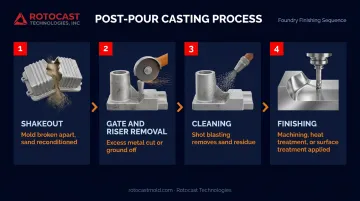
Types of Sand Casting Processes
Not all sand casting uses the same mold system. The two most common approaches — green sand and no-bake — serve different quality and production needs.
Green Sand Casting
Green sand is the most widely used method. The AFS describes it as industrial sand bonded with bentonite clay, water, and carbonaceous material. FHWA data indicates a typical mix of approximately 10% bentonite, 2–5% water, and 5% sea coal.
The word "green" refers to the uncured, damp state of the mold — not its color. Green sand molds are cost-effective, the sand is recyclable through many production cycles, and the process is well-suited for aluminum and iron castings at most production volumes.
No-Bake (Air-Set) Casting
No-bake sand uses a chemical resin binder mixed with a liquid catalyst. The mold hardens into a rigid, brick-like state at room temperature without heat or moisture. The result is a harder, more dimensionally stable mold than green sand produces.
Casting Source reports no-bake tolerances of ±0.005 to ±0.015 inches, and ASM confirms that no-bake improves dimensional tolerance control versus green sand. The tradeoff is higher material cost and less recyclability.
The table below shows how the two methods compare across the factors that matter most for most casting decisions:
| Factor | Green Sand | No-Bake |
|---|---|---|
| Cost | Lower | Higher |
| Surface finish | Good | Better |
| Dimensional stability | Moderate | High |
| Best for | High-volume, simpler geometry | Complex, tight-tolerance parts |
For aluminum castings, wall thickness requirements and interior surface quality targets are usually the deciding factors between the two.
Where Sand Casting Is Used
Sand casting is the foundational process for producing near-net-shape metal components across industries. The AFS lists defense, automotive, construction, agriculture, aerospace, and oil and gas among the sectors that depend on metalcasting — and states that 90% of manufactured goods contain metal castings.
The process performs best under these conditions:
- Low-to-medium production runs where die tooling costs can't be justified
- Parts with complex internal features, undercuts, or large cross-sections
- Designs requiring metals with moderate melting points, particularly aluminum
- Applications where post-cast machining handles final dimensional requirements
Sand Casting in Aluminum Rotational Mold Production
One of the more demanding applications for sand casting is the production of aluminum rotational molds — the tooling used to produce hollow plastic parts in the rotational molding process. These molds require thin, uniform wall sections (typically ¼" to 3/8") with defect-free interior surfaces, because any surface flaw in the mold transfers directly to every part produced from it.
The quality bar is high enough that only a handful of North American foundries consistently produce aluminum castings that meet these requirements. Rotocast Technologies, based in Akron, Ohio, has built its foundry practice around exactly this application.
Their process expertise comes from a heritage of producing aluminum tire molds — equally demanding work — which translates directly to the thin-wall, high-surface-quality castings that rotational molders need.
Rotocast uses A356.2 grade aluminum alloy, which carries stricter chemical limits and is made from primary aluminum. Compared to standard 356.0, A356.2 delivers higher elongation, greater strength, and better ductility — all critical when a mold undergoes hundreds of thermal cycles in production.
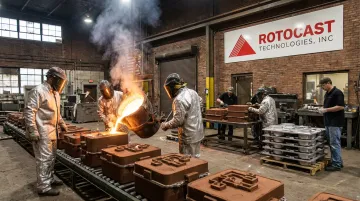
The uniform wall thickness achieved through their foundry process ensures consistent heat transfer to the resin inside the mold, which directly affects part quality and cycle time for the molder.
Conclusion
Sand casting works because every variable in the process is connected. The pattern determines cavity geometry. The gating system governs fill quality. The sand mixture controls surface finish and permeability. The pour temperature and rate affect porosity and structural integrity. Get the sequence right, and the result is a near-net-shape metal part with the geometry, density, and surface quality the application demands.
That process knowledge matters most when the casting becomes a production tool. For manufacturers sourcing cast aluminum molds, understanding how sand casting works sharpens every conversation with a foundry partner — on gating design, sand process selection, alloy choice, and finishing requirements — and leads to better outcomes from tooling that runs for years in production.
Rotocast Technologies has been doing this work since 1956, with a workforce averaging 16 years of specialty casting experience. The company operates its own foundry in Akron, Ohio, and has spent decades refining a thin-wall pouring process built around one outcome: dense, high-surface-quality aluminum molds for rotational molders.
Frequently Asked Questions
What is a sand mold for aluminum?
A sand mold for aluminum is a cavity formed from compacted sand (typically green sand or no-bake sand) shaped around a pattern that replicates the finished part. When molten aluminum is poured in and solidifies, it takes the cavity's shape and is extracted after the mold is broken apart.
What type of sand is used for aluminum casting?
Aluminum casting most commonly uses silica sand mixed with bentonite clay and water (green sand) or a resin binder (no-bake). Olivine sand is sometimes used as an alternative to silica because it has lower thermal expansion and reduces silica dust exposure concerns.
What is the difference between green sand and no-bake sand casting?
Green sand uses moisture and clay to bond the sand and is never fully cured, while no-bake uses a chemical resin binder that hardens at room temperature. No-bake produces a harder, more dimensionally stable mold, though at higher material cost.
What metals can be sand cast?
Sand casting works with a wide range of metals — aluminum, cast iron, steel, brass, and bronze among them — covering both ferrous and nonferrous alloys. Aluminum is among the most commonly sand cast metals due to its lower pour temperature and excellent castability.
What is a pattern in sand casting?
A pattern is a physical replica of the final part made from wood, metal, or plastic, pressed into sand to create the mold cavity. It is built slightly larger than the finished dimensions to account for metal shrinkage during solidification.
How accurate is sand casting compared to other methods?
Sand casting has lower dimensional precision than die casting or investment casting due to sand grain variability and mold permeability. No-bake processes and finer sand grades improve accuracy, and post-cast machining of critical surfaces is standard practice when tight tolerances are required.